 plan
planAurum Land’s S$84.2 million Watten Estate deal sets a benchmark—with limits
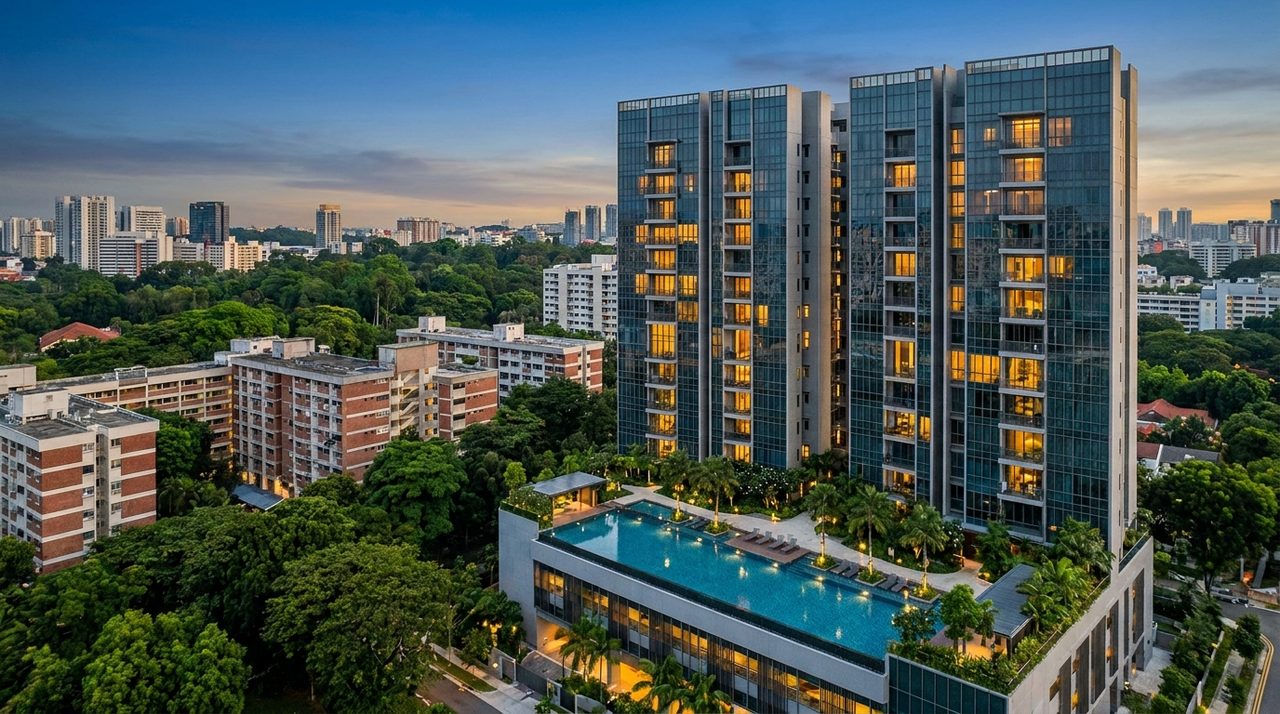
The freehold purchase confirms demand for rare redevelopment-scale land in Bukit Timah, but its S$2,266 psf rate is not a ready-made valuation for every nearby home.
Far East Organization’s sale of 134 Watten Estate Road for S$84.2 million gives Singapore owners and buyers a confirmed benchmark for an unusually large freehold redevelopment site. It does not give every nearby landed home a new valuation.
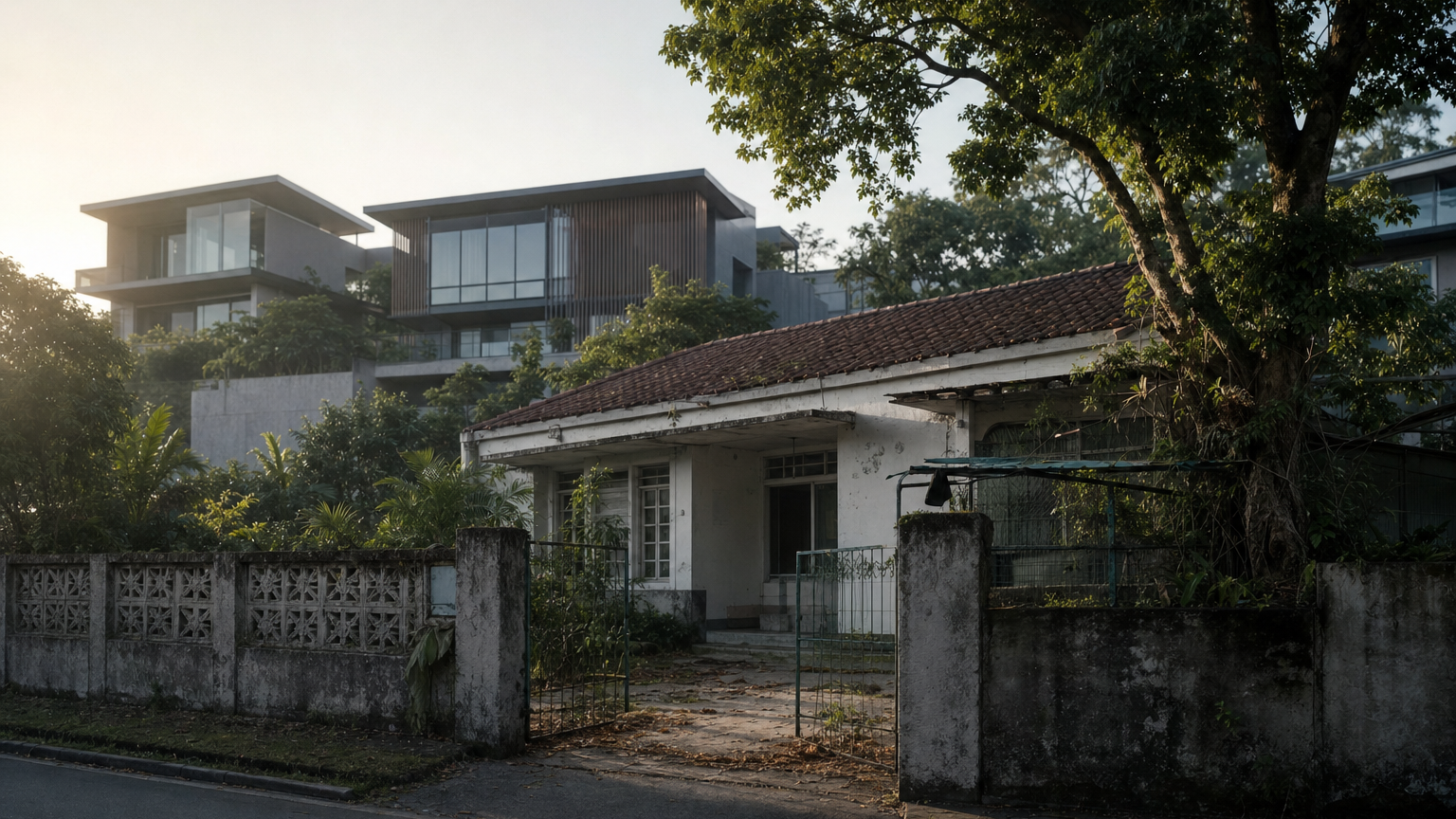
The distinction is central. Aurum Land bought two adjoining parcels totalling about 37,155 sq ft, with a three-storey walk-up apartment block on the larger parcel. At about S$2,266 per sq ft of land, the transaction reflects scale, site control and redevelopment potential that an ordinary bungalow, semi-detached house or terrace may not possess.
The buyer paid for a redevelopment platform
The larger parcel measures about 32,953 sq ft, while the adjoining land adds roughly 4,202 sq ft. The property was held through Lucky Realty Company, a Far East subsidiary, and the existing walk-up apartments date from the 1970s.
A reported caveat records Aurum Land as the buyer, providing stronger evidence than an asking price or marketing guide. The property had been offered for sale for at least six months and attracted several offers before the transaction.
Yet the implied S$2,266 psf is not a pure measure of what one square foot of ordinary residential land in the neighbourhood is worth. Aurum Land secured control of two adjoining parcels and a site large enough to support a commercial redevelopment exercise, subject to planning and technical approvals.
That optionality has value. A developer can consider how to divide the land, what housing form to pursue and how to position multiple new homes. A family buying one existing house usually evaluates a different package: the home’s condition, immediate utility, rebuilding budget and suitability for occupation.
This is a price for a redevelopment platform, not a universal neighbourhood benchmark.
The buyer must also carry costs that sit beyond the headline land rate. Demolition, design, financing, construction and professional expenses all affect the economics, as do the eventual number of approved homes and the prices buyers will accept. The reported acquisition price reveals none of those assumptions.
Why S$2,266 psf cannot be copied across Watten Estate
Property comparisons work best when the assets share material characteristics. Here, the scale and assembly of the site sharply limit how directly the transaction can be compared with a conventional house.
Consider two hypothetical properties sold at the same land rate. Applying S$2,266 psf to a 5,000 sq ft plot produces an arithmetic value of about S$11.33 million. But that multiplication says nothing about whether the smaller plot has comparable frontage, shape, access, redevelopment flexibility or market demand.
The differences can be summarised as follows:
| Factor | 134 Watten Estate Road | Conventional individual home |
|---|---|---|
| Site control | Two adjoining parcels | Usually one plot |
| Reported area | About 37,155 sq ft | Often materially smaller |
| Buyer’s likely purpose | Commercial redevelopment | Occupation, rebuilding or resale |
| Existing use | Walk-up rental apartments | Commonly one landed home |
| Key valuation issue | Achievable development yield | Plot and building utility |
The table’s transaction details follow the reported sale; the comparison with a conventional home is editorial analysis.
A nearby owner can legitimately use the deal as evidence that substantial capital is interested in scarce freehold land in the estate. But a defensible valuation still needs closer comparables and adjustments for plot configuration, frontage, road conditions, building age and redevelopment constraints.
The strongest counterargument is that a large developer transaction can lift expectations throughout a tightly held estate. That may happen at the level of seller sentiment. It does not mean subsequent buyers will accept the same rate for sites that offer less development potential.
The housing yield remains unknown
Aurum Land is understood to be considering a landed development, but that remains a reported intention rather than an approved scheme. No public details reviewed for this article establish the final housing type, layout, unit count, launch timing or prices.
URA’s prevailing guidance states that a new side-to-side semi-detached plot generally requires a minimum plot area of 200 sq m and width of 8 metres. Different requirements apply when an existing semi-detached house is redeveloped, while site-specific planning considerations can still govern an application.
The combined site is approximately 3,451 sq m. Dividing that area by 200 sq m gives a purely mathematical result of about 17 plots, but it would be misleading to present this as a probable project yield.
Land cannot ordinarily be divided by area alone. Plot widths, access, setbacks, road and drainage requirements, site shape, building envelopes and technical-agency conditions can consume or constrain developable space. URA also retains discretion to assess proposals against their particular circumstances and impose conditions.
The relevant evidence will therefore be a planning submission followed, if approved, by particulars showing the permitted housing form and layout. Until then, any confident unit-count forecast amounts to speculation.
This uncertainty matters because development yield is one of the principal mechanisms connecting the land price to eventual new-home prices. Fewer approved homes would spread land and common project costs across fewer saleable properties; a more efficient layout could produce a different equation. Neither outcome is established yet.
What nearby owners can reasonably take from the sale
For owners of large plots—or neighbours exploring whether adjoining sites could be sold together—the deal is a meaningful reference. It demonstrates completed buyer interest in a sizeable, assembled freehold holding in Bukit Timah rather than merely an owner’s aspiration.
Its relevance falls as the comparison property becomes less similar. A single house with a narrow frontage, irregular site, ageing structure or limited subdivision potential may appeal mainly to owner-occupiers. That is a different buyer pool from a developer underwriting multiple future homes.
The sale may nevertheless influence local conversations. Owners may revise asking expectations, while agents may cite it when discussing scarcity. Those reactions are possible market effects, not proof that achievable prices have risen by a particular amount.
There is also no evidence in the reported transaction that the developer’s eventual revenue will justify the land cost. The deal confirms what Aurum Land agreed to pay; it does not disclose its target margin, financing assumptions, construction budget or expected sales pace.
Aurum Land’s experience makes the redevelopment thesis plausible. It previously acquired the freehold Kew Lodge site at Kheam Hock Road and subsequently developed eight landed homes there. That precedent indicates relevant execution experience, but it does not establish that Watten Estate will follow the same unit mix or timetable.
Buyers face opportunity and disruption—not a confirmed launch
For buyers seeking a new landed home in the area, the acquisition points to possible future supply. It does not yet constitute a project launch, and there is no supported basis for assuming a particular product or price.
Buyers of existing nearby homes should also account for the site’s transition. If redevelopment proceeds, demolition, construction traffic and noise could affect the immediate surroundings for a period. The timing and extent remain uncertain because no construction programme has been reported.
That does not necessarily impair long-term neighbourhood appeal. Replacement of an older apartment block with a well-executed landed scheme could ultimately refresh the streetscape and add newer housing stock. This is an interpretation of a possible outcome, not a confirmed benefit.
Existing tenants occupy a more immediate but still uncertain position. A change of ownership does not, by itself, disclose when tenancies end or when redevelopment starts. Individual lease terms and formal communication from the owner remain more reliable than assumptions based on the sale alone.
The seller monetises history; the buyer assumes execution risk
Far East had held the property through its subsidiary since the 1970s and used it as a rental asset. Selling converts that long-held property into cash and transfers the risks of planning, construction and future sales to Aurum Land.
That division of risk is the quieter meaning behind the headline price. The seller has crystallised value now. The buyer must still turn costly land into an approved and commercially viable product.
The transaction consequently supports a narrow conclusion: developers remain willing to commit substantial capital to rare, large freehold sites with redevelopment potential in established Bukit Timah landed areas. It does not prove that the entire landed market has repriced or that every older property is a viable development site.
The next decisive development will not be another neighbourhood asking price. It will be a planning submission or approval revealing what Aurum Land can actually build at 134 Watten Estate Road. That will determine whether S$84.2 million bought an efficient landed scheme—or an expensive parcel with tighter constraints than its headline area suggests.