 plan
planOne Fort reaches $2,100 psf as selective demand lifts District 15 freehold resales
Three boutique projects have established new price records, but their thin transaction histories and softer wider-market data argue against treating the deals as a new District 15 benchmark.
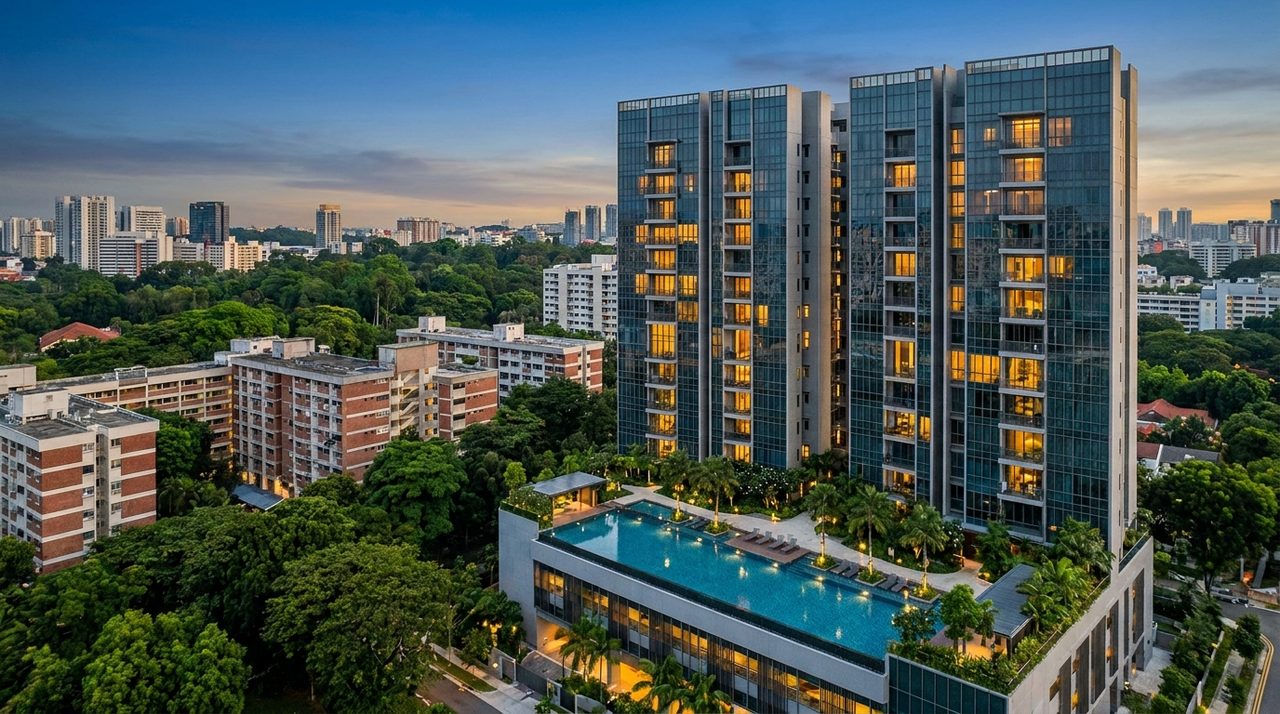
A 1,238 sq ft, three-bedroom apartment at One Fort changed hands for $2.6 million, setting a project high of $2,100 psf. The 19th-floor transaction, dated 31 August 2026, surpassed the condominium’s previous psf peak of $2,078, set in January 2025.
The sale answers a narrow but useful question: buyers will pay about $2,100 psf for the right larger apartment in this small freehold Fort Road development. It does not establish a new valuation for every unit at One Fort, much less every freehold home in District 15.
That distinction matters because two other boutique freehold projects—De Centurion in Tanjong Rhu and The Eastside in Joo Chiat—also registered project records during the same review period. Together, the deals suggest selective competition for established freehold homes, but the wider market data does not support treating them as a district-wide price reset.
One Fort’s gain was incremental, not a price leap
One Fort’s previous record involved a 1,227 sq ft, three-bedroom unit sold for $2.55 million, or $2,078 psf, in January 2025. Comparing the two reported psf figures gives an increase of approximately 1.06%.
That calculation puts the new headline in proportion. The record moved by $22 psf, while the absolute consideration increased by $50,000. This is evidence of resilience at the top of One Fort’s recorded range, rather than a sudden repricing by hundreds of dollars per square foot.
Nor is this a repeat sale of the same apartment. The latest property was larger and on the 19th floor, and it transacted about 19 months after the previous record. Differences in elevation, facing, layout, condition and negotiations can all affect what a buyer will pay, even within one block.
One Fort is a 79-unit freehold development completed in 2005. In a condominium of this size, relatively few resales can make each new caveat appear more consequential than it would in a large estate with frequent transactions.
A simple illustration shows the limitation. Applying $2,100 psf mechanically to a 1,000 sq ft apartment produces a notional value of $2.1 million, but that arithmetic says nothing about whether the smaller home has the same floor, outlook, efficiency or buyer pool as the record unit. The rate is a comparison tool, not an automatic valuation formula.
Three records, but three distinct micro-markets
De Centurion recorded a new high when a 775 sq ft two-bedroom apartment sold for almost $1.6 million, or $2,058 psf, on 1 September 2026. The 42-unit freehold project’s previous record was $2,035 psf in February 2026, so its latest increase was also about 1.1%.
At The Eastside, a 1,206 sq ft three-bedroom apartment fetched $2.45 million, or $2,032 psf, on the same date. This was the Joo Chiat development’s first recorded sale above $2,000 psf and its first caveated transaction since 2023; its preceding high was $1,927 psf.
The projects share some characteristics. All are small freehold developments in District 15, and all have thin enough transaction histories for a single deal to establish a fresh benchmark.
Their locations and housing propositions nevertheless differ. Fort Road occupies the Kallang–Katong edge; Tanjong Rhu serves a city-fringe and waterfront-oriented market; Joo Chiat offers a different streetscape and amenity mix. A buyer choosing among them is not merely selecting the cheapest rate within one homogeneous neighbourhood.
Unit sizes also complicate the comparison. De Centurion’s record involved 775 sq ft, whereas the One Fort and Eastside sales exceeded 1,200 sq ft. Smaller apartments can sometimes sustain higher psf rates because their lower absolute prices widen the potential buyer pool. Here, however, the two larger apartments also crossed $2,000 psf, indicating that the demand was not confined to compact units.
The more defensible interpretation is therefore selective price discovery. Buyers accepted record rates for particular apartments in tightly held freehold projects. Three records make that pattern more noteworthy than one, but they still represent three individual choices rather than a District 15 index.
The wider market provides a strong counterargument
URA’s second-quarter 2026 data presents a cooler aggregate picture. Overall private residential prices rose 0.5% during the quarter, but non-landed prices slipped 0.1%. Prices in the Rest of Central Region, the broad segment containing District 15, declined 1.2%.
This does not contradict the three sales. An index measures the combined movement of a market segment, while a caveat records the agreed price for a particular property. Scarce or unusually attractive homes can set records during a softer quarter.
It does challenge the claim that the transactions prove a broad upswing. If District 15’s freehold resale market had undergone a general step-change, one would expect depth: repeated sales across more developments, floors, apartment sizes and conditions—not just isolated peaks in boutique projects.
Supply also tempers the scarcity argument. At the end of the second quarter of 2026, 42,472 private homes, including executive condominiums, had planning approval in the pipeline, of which 15,810 remained unsold. URA also reported that about 60,600 units were expected to be completed over the following years, while the 2026 Government Land Sales Confirmed List would provide capacity for 9,320 private homes.
These islandwide figures are not direct substitutes for an established freehold apartment on Fort Road. New homes may differ in tenure, size, location and completion date. Still, the pipeline means purchasers can compare older District 15 resales against new launches and other city-fringe options; sellers cannot safely assume that “freehold” eliminates competition.
What the sale changes for owners
For a One Fort owner, the transaction supplies a current and relevant comparable. It demonstrates that one buyer accepted $2.6 million for a higher-floor, family-sized apartment and that the project can support a $2,100 psf caveat under suitable conditions.
That may strengthen an owner’s negotiating position, especially where the home resembles the record apartment. It may also influence the starting range considered by prospective sellers, buyers and valuers.
But the record is not an entitlement. A lower-floor home, compromised outlook, dated interior or less efficient layout could trade below it. Conversely, a superior unit might attract more, although that conclusion would require actual buyer offers rather than a simple multiplication exercise.
Owners elsewhere in District 15 should apply a larger discount to the comparison. Tenure is only one variable. Project age, maintenance, access, unit mix, transaction frequency and the total purchase price can produce materially different demand even between nearby condominiums.
Caveated sales remain more useful evidence than advertised asking prices because URA’s resale and sub-sale transaction records are based on caveats lodged with the Singapore Land Authority. Asking prices reveal seller expectations; caveats show deals that were actually concluded, subject to the limits and timing of the available record.
The best reading is therefore a range, not a single number. Owners can place the record beside recent transactions within their own project, then test it against genuinely comparable apartments nearby. The less similar the home, the less weight One Fort’s $2,100 psf should carry.
What buyers should compare with the record unit
For a buyer, the starting point is the $2.6 million total commitment, not the headline rate alone. PsF helps compare different floor areas, but the absolute price determines the required equity, financing exposure and opportunity cost.
The actual benchmark is specific: 1,238 sq ft, three bedrooms and the 19th floor. A prospective buyer should ask how much of any premium reflects usable internal area, elevation, orientation and condition—and how much simply reflects a seller pointing to the latest record.
Thin transaction histories deserve particular care. The Eastside’s new peak followed its first caveated transaction since 2023. Scarcity may support pricing when the right buyer appears, but fewer transactions also provide less evidence about resale liquidity and the level at which demand becomes repeatable.
The strongest case for paying a premium is straightforward. Freehold tenure, established eastern neighbourhoods and limited availability of larger homes may be difficult to reproduce. A household intending to occupy a suitable apartment for many years may reasonably value those attributes more highly than a broad quarterly index.
Yet freehold status does not make every price equivalent. A newer leasehold home may offer more efficient space or facilities; another resale may provide similar family utility at a lower total cost. The relevant question is not whether $2,100 psf has now been “proven”, but whether the specific apartment justifies its premium over realistic alternatives.
The next sale will be more revealing than the record
One Fort’s new high is meaningful because it improves the project’s evidence base and confirms demand at the upper end of its recorded range. Its limited 1.1% increase over the previous peak, however, makes this a consolidation signal rather than a dramatic revaluation.
The next comparable One Fort transaction will show whether $2,100 psf is repeatable. Across District 15, the more important development to watch is whether boutique-project records broaden into sustained caveated activity across different projects and apartment types—or remain isolated purchases in a market whose wider RCR index is still giving a more restrained signal.